

Why Can’t You Just Uninstall Viber ChatGPT: How the Company Arbitrarily Takes Control of Users’ Privacy
Viber promotes itself as a secure app with end-to-end encryption, yet at the same time aggressively pushes ChatGPT features—and does not allow users to have true control over them. Some time ago, Viber added the ChatGPT AI to its messaging app, but the AI feature cannot be completely turned off or removed.
If the AI feature is enabled without a truly functional option to turn it off, then the user has no real choice. This is particularly sensitive in conversations where personal, work-related, or intimate information is discussed.
This is a serious issue under the GDPR, as messaging is a service where people expect privacy and clear control over what remains in the app and what does not.
What Happens in Practice?
Despite extensive settings set to “off” and “Disconnect ChatGPT,” the AI features still pop up in chats, suggestions, and folders for Viber Rakuten Messenger users.
When you go to settings:
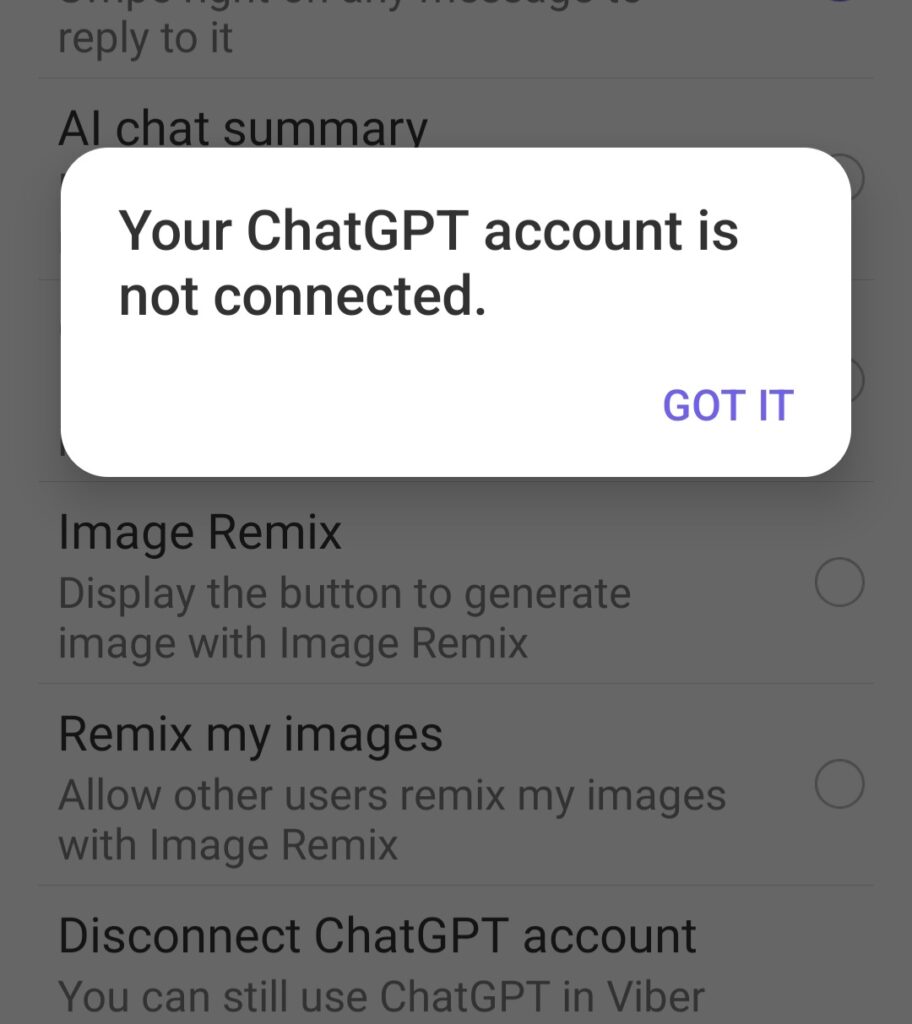
Viber displays a notification that ChatGPT is “turned off.”
However, the only option for ChatGPT does not have an on/off toggle.
Sometimes it appears as an “issue,” other times it calmly states that it’s “turned off”—even though the AI remains active in the background and pops up from every corner.
The irony is complete: if you wanted to turn the feature on, it’s clearly difficult or impossible to do so, while turning it off is illusory.
Why is this a problem?
Every time you use AI features, content from the E2EE-protected bubble is sent to OpenAI. Sensitive conversations (business, medical, family) may inadvertently become part of a third party’s data.
This is a classic “dark pattern”—the intentional design of an interface that makes it difficult or impossible for the user to make an informed choice.
Viber claims that these features are “on demand” and require consent, but the reality is different: the integration is deep, and the opt-out option is either limited or non-existent.
The GDPR Requires Clear Consent
Under the GDPR, it is not sufficient for something to be written in internal rules or hidden in lengthy terms of use. Consent must be clear, voluntary, specific, and revocable, and the user must also have a realistic opportunity to refuse it.
If the AI in an app is configured in such a way that the user cannot easily remove it, it is difficult to consider such a model as truly consent-based. This is precisely why the problem lies in the very method of implementation, not just in the wording of the policy.
Why this bothers me as a user
Large companies often talk about transparency, but based on their experiences, users are increasingly skeptical of these claims. When AI is introduced into a messaging app without a clear opt-out option, it quickly creates the feeling that privacy is no longer in the user’s hands.
Comparison with others
If we compare Viber with other major messaging platforms, it becomes clear that AI in messaging apps is no longer an exception but a new direction in development. On WhatsApp, Meta’s AI may be present more discreetly or gradually, while on Facebook Messenger, the integration is already more obvious, meaning that users often no longer feel like they’re just using a regular chat app. That’s precisely why it’s so much more important for Viber to offer a clear and truly functional option to turn it off—or a separate app—for those who want to use AI.
A separate app would be a fairer solution
The most sensible solution would be a separate app—such as Viber AI—for users who want AI features. The basic Viber app would thus remain a standard messenger without any additional data processing.
This would mean a clearer choice, less confusion, and more trust. Users who value privacy highly would use the basic app, while others would use the separate AI solution.
Therefore, the main problem is simple: if the choice isn’t real, neither is the consent. And for an app where people write their most personal thoughts, this is hard to accept.
What can you, as a user, do?
Hide the AI chats folder (long press → Manage folders → Hide). In the settings, try disconnecting ChatGPT, then clear the cache and app data. For serious privacy, we recommend switching to Signal or Telegram.
Long-term: file a complaint with European authorities (GDPR) and spark a broad public discourse. Only public debate can, at least in part, counteract the autocrats or support public pressure.
Viber isn’t the only one, but it’s currently one of the most aggressive when it comes to pushing AI in Europe. Until users demand real control, companies will continue with the “turn it on first, then let users adapt” approach.
If it bothers you that you have no right to control the app or your own data, and that ChatGPT interferes with your anonymous conversations while your chats are sent to a server at an unknown location, please write to us or leave a comment.